1 in 7
Workers in Great Britain provide unpaid care to someone with an illness, disability or age-related needs.
Source: Department for Work and Pensions, 2026.
Support works best when it becomes a clear workplace response.
Serious illness · Caring responsibilities · Anticipatory grief · Bereavement
When personal circumstances change an employee's capacity, work is often affected long before formal absence or disclosure. Most organisations already have support provision in place. The critical challenge is ensuring that support turns into consistent, confident, and compassionate action for both managers and employees.

Why it matters
Serious life circumstances often affect work before they become formal HR, wellbeing or absence cases. By the time the issue is visible, the organisation may already be managing presenteeism, absence risk, missed deadlines, retention pressure or operational strain.
Workers in Great Britain provide unpaid care to someone with an illness, disability or age-related needs.
Source: Department for Work and Pensions, 2026.Of working unpaid carers reduced their working hours in the previous 12 months to provide care.
Source: Department for Work and Pensions, 2026.Of employed unpaid carers had discussed their caring responsibilities with their employer.
Source: Department for Work and Pensions, 2026.These figures do not prove that every serious life transition leads to reduced performance. They show why employee capacity, management practice and organisational response matter commercially.
Tender Transitions
Tender Transitions helps organisations respond more clearly and consistently when serious illness, caring responsibilities, anticipatory grief or bereavement begin to affect work.
Clarify pathways, decision principles, responsibilities and follow-up, so employees and managers are not left to work out the next step alone.
Practical guidance for recognising changing capacity, holding appropriate conversations, setting boundaries and involving specialist support.
Practical support to recognise changing capacity, consider workload and boundaries, communicate needs and access appropriate support.

Organisational Readiness Check
Explore how your organisation responds across Recognition, Manager Capability, Response, Coordination and Follow-through. This is a reflective organisational tool, not a clinical, legal or compliance assessment.
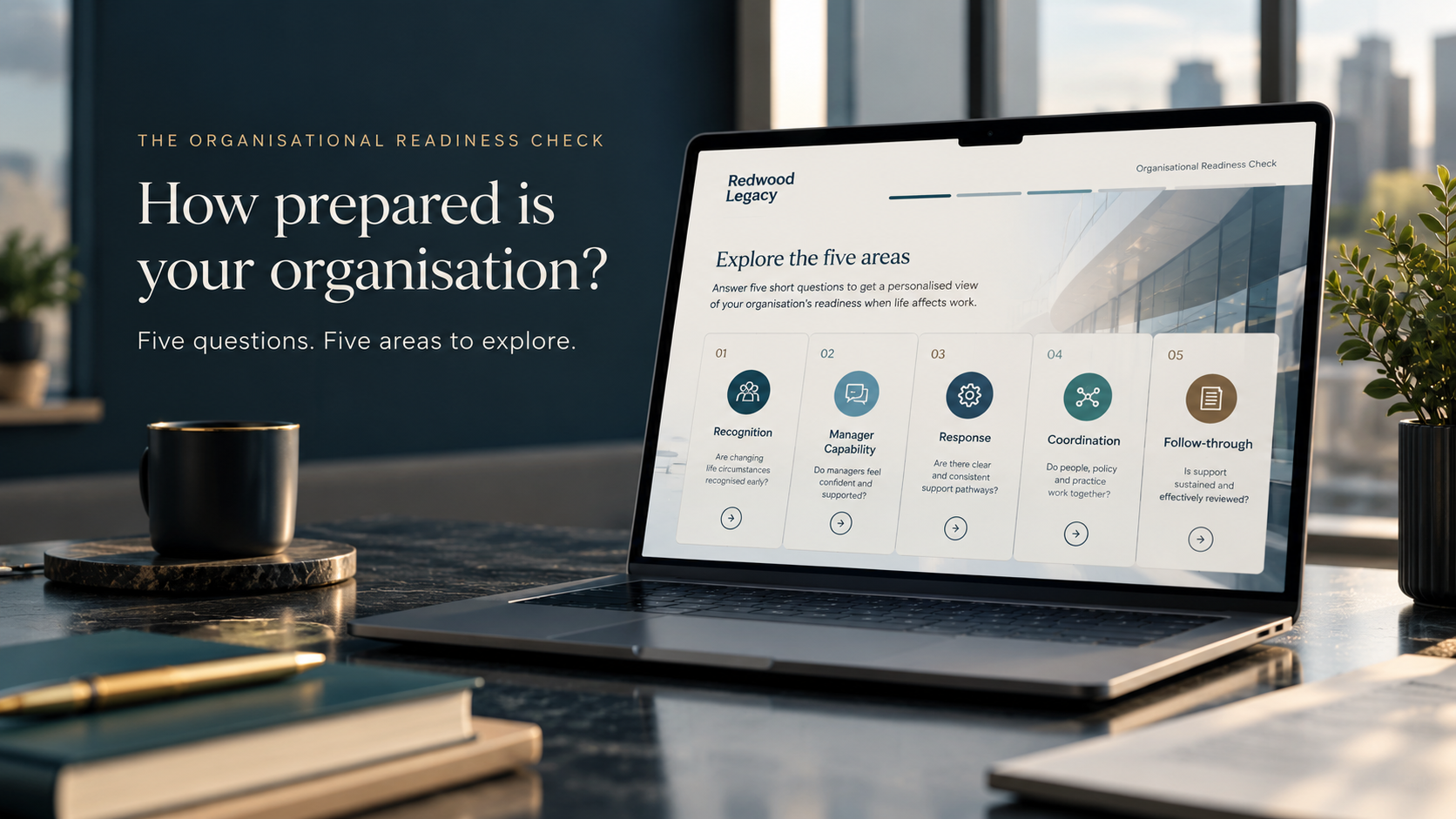
Recognition
Think about serious illness, long-term caring, and anticipatory grief before the conversation is forced.
From provision to practice
Capacity may change gradually. Managers may rely on instinct. Support can vary by team. Tender Transitions creates a clearer, more consistent workplace response.
Clear boundariesManagers are supported without being turned into counsellors.
Identify changing capacity and begin an appropriate workplace conversation earlier.
Make clearer judgement calls around workload, boundaries, support and escalation.
Coordinate responsibilities and review support as circumstances and capacity change.

About Redwood Legacy
Redwood Legacy was founded by Carmen Bruce-Annan to address a workplace issue she understands from more than one angle. Her lived experience brings insight into caring, anticipatory grief, bereavement and the pressure of continuing professional responsibilities while life is changing.
Tender Transitions brings those perspectives into a structured B2B offer for organisations, managers and employees. Redwood Legacy's work is grounded in human experience, shaped by organisational reality and supported by published evidence where workforce and commercial claims are made.
FAQs
EAPs and wellbeing programmes provide valuable support once an employee reaches out, but they do not guide how a line manager identifies early changes in capacity. Tender Transitions strengthens the organisational response that surrounds your existing provision.
Policies set formal entitlements and leave periods, but they rarely govern the day-to-day conversations, boundary setting, workload adjustments, and ongoing review needed when personal circumstances fluctuate.
No. In fact, it protects managers by giving them clear boundaries. Tender Transitions clarifies what sits within their remit and provides exact pathways for when and how to escalate.
If your organisation experiences varied outcomes depending on which manager an employee happens to have, or if you frequently discover serious capacity strain only after an employee resigns or takes prolonged sick leave, a structured framework will provide immediate consistency and risk reduction.
Start a practical conversation
Organisations cannot prevent serious illness, caring responsibilities, anticipatory grief or bereavement from affecting employees. They can be better prepared for what happens at work when capacity changes.